NOTICE:
Our official email addresses are temporarily unavailable as we implement server updates and improvements.
We apologize for any inconvenience and appreciate your patience.
In the meantime, please contact our CEO at
[email protected],
call or WhatsApp
+265 881 449 449,
or message us on
LinkedIn
and
Facebook.
Email services will be restored as soon as possible.
GTQF Contributes to United Nations Education Advocacy
By:
Saturday, August 1, 2026
Donation
GTQF Contributes to United Nations Education Advocacy.
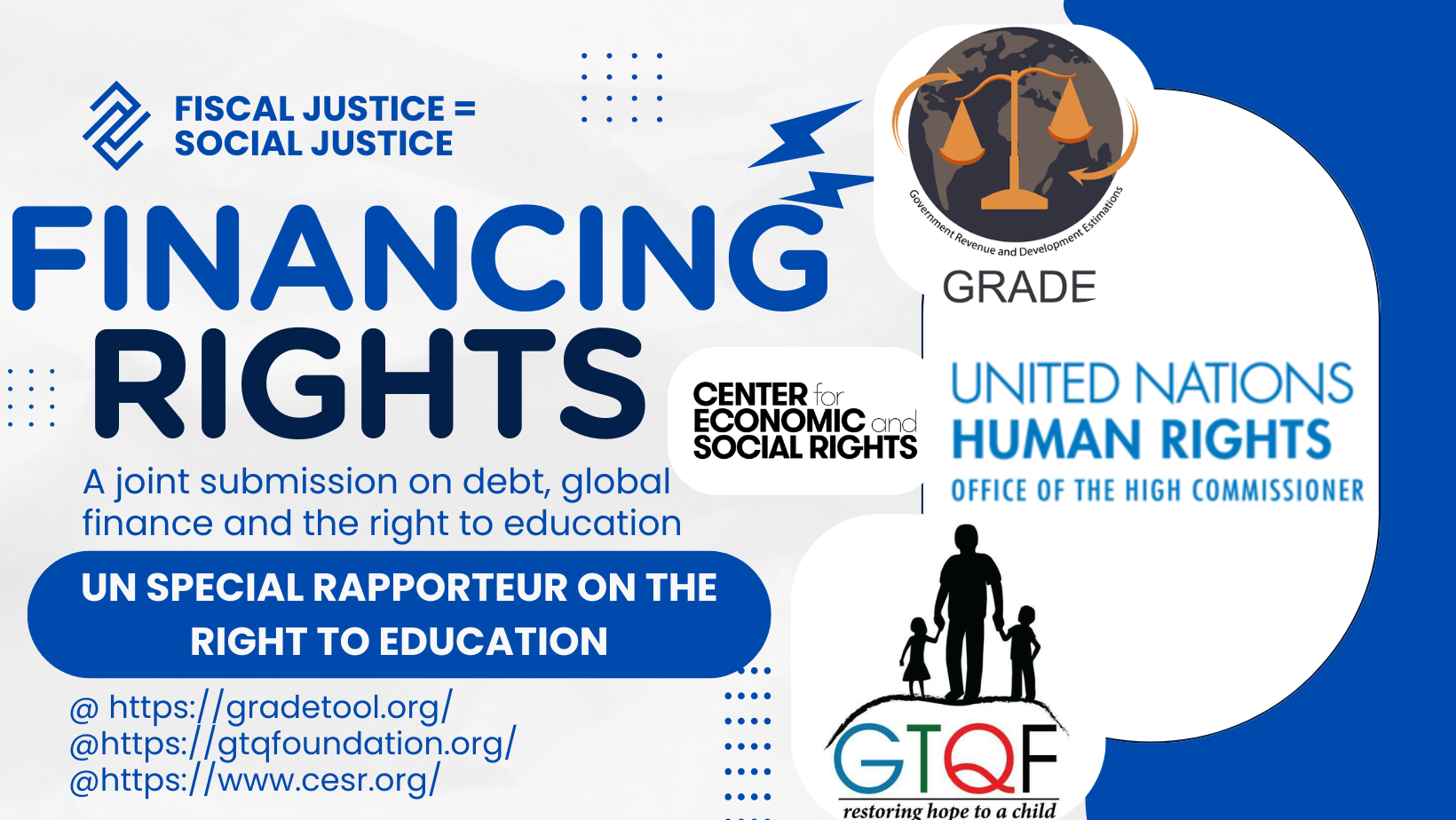
A joint submission on debt, global finance and the right to education
At the Grown Too Quick Foundation (GTQF), we believe that achieving the right to education requires more than ensuring children have access to classrooms. It also requires confronting the economic and financial structures that determine whether governments have the resources to provide quality education for all.
This commitment recently took GTQF into an important global policy space, through a joint submission on “The International Financial Architecture, Debt and the Right to Education” to the United Nations Special Rapporteur on the Right to Education. The submission was jointly prepared by the Government Revenue and Development Estimations (GRADE) at the Universities of St Andrews and Leicester, the Center for Economic and Social Rights (CESR), and The Grown Too Quick Foundation (GTQF).
Why does global finance matter for education?
For many low- and middle-income countries, limited fiscal space can make it difficult for governments to adequately invest in essential public services, including education.
High debt-servicing obligations, constrained public revenues and wider weaknesses in the international financial architecture can affect the resources available for schools, teachers, learning materials and other services that children and young people depend on.
For GTQF, these are not simply economic or financial questions. They are questions of children’s rights, social justice and equality of opportunity.
When public resources are constrained, the consequences can be felt most severely by children and young people from vulnerable and low-income communities.
The joint submission contributes evidence and perspectives to the UN Special Rapporteur’s work on the relationship between the international financial architecture, debt and the right to education.
The submission has since been published on the Office of the United Nations High Commissioner for Human Rights (OHCHR) website and will inform the Special Rapporteur’s annual thematic report on the right to education, which is expected to be presented at the 81st session of the United Nations General Assembly.
For GTQF, this represents an important milestone.
It demonstrates how evidence generated through research and community-focused organisations can move beyond local advocacy and contribute to international human rights processes.
GTQF’s contribution is rooted in our experience working with children and young people in Malawi, where economic vulnerability continues to affect access to education and opportunities for social mobility. Our participation also reflects a broader conviction: young people and grassroots organisations should not simply be subjects of policy discussions, they should be contributors to them. In this way, we can help decision-makers better understand how global economic decisions affect people’s everyday lives.
Evidence, partnership and advocacy
This submission also highlights the value of collaboration.
The partnership between GRADE, CESR and GTQF brings together research, human rights expertise and grassroots perspectives. Such collaboration allows complex global issues to be examined not only through economic data, but also through the lens of human rights and lived realities.
For GTQF, this is precisely what meaningful advocacy should achieve: connecting evidence with lived experience, local realities with global policy, and youth voices with decision-making spaces.
As a growing youth-focused organisation, being part of a submission that contributes to a UN Special Rapporteur’s thematic work is an encouraging milestone.
It reinforces our commitment to advancing education equity, fiscal justice, child rights and social protection, while demonstrating that organisations working at community level can play a meaningful role in shaping global conversations.
We are grateful to our partners at GRADE and CESR for this collaboration and to the UN Special Rapporteur’s mandate for creating space for evidence and diverse perspectives.
Our work continues: from communities to global policy spaces, we will continue advocating for systems that ensure children inherit possibilities—not poverty.
Read the submission
The joint submission and other contributions are available through the OHCHR’s call for inputs on “The International Financial Architecture, Debt and the Right to Education.”
#RightToEducation #DebtJustice #FiscalJustice #YouthAdvocacy #EducationEquity #GTQF #OHCHR #GlobalJustice #UN Special Rapporteur on the Right to Education